
L-Citrulline vs L-Arginine: Which Is Better for You?
L-Citrulline vs L-Arginine: Which Is Better for Nitric Oxide?
L-Citrulline vs L-Arginine which is better is one of the most common questions when choosing a nitric oxide supplement. In this evidence-based comparison, we analyze absorption, effectiveness, and real benefits for blood flow and performance. If you’ve researched nitric oxide boosters, you’ve likely encountered L‑arginine and L‑citrulline. Both increase arginine levels, but they work differently.
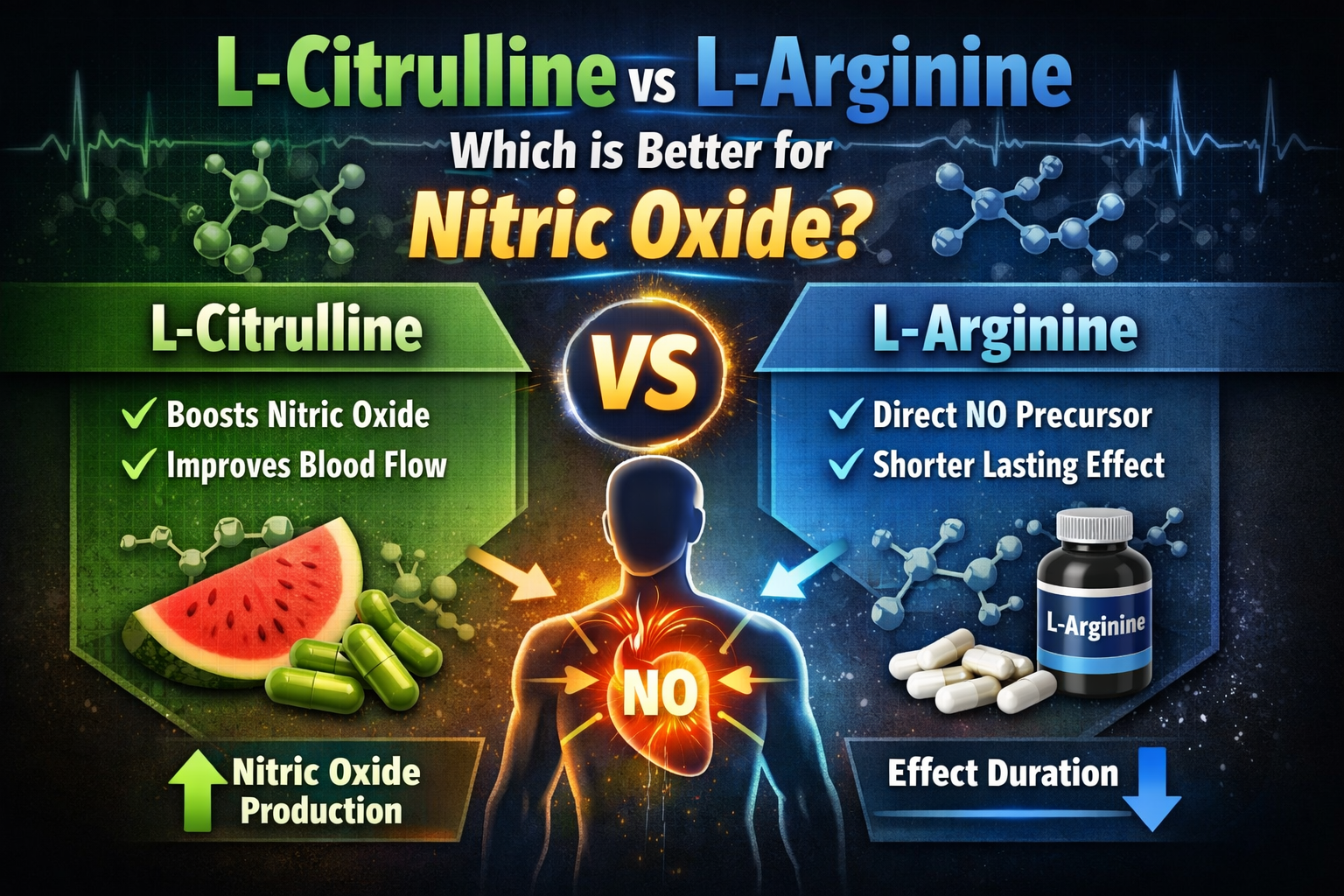
Visual comparison: absorption and nitric oxide pathway
✅ L‑Citrulline Strengths
- Better absorbed, no first‑pass metabolism
- Produces higher and sustained arginine levels
- Less digestive upset (no diarrhea at effective doses)
- More effective for exercise performance
⚠️ L‑Arginine Limitations
- Poor oral bioavailability (quickly broken down in gut)
- Common side effects: bloating, diarrhea, nausea
- Requires very high doses (often >10g) for modest effect
- May not be ideal for long‑term daily use
To better understand L-Citrulline vs L-Arginine which is better, the table below summarizes key differences in absorption, dosing, and physiological impact.
L-Citrulline vs L-Arginine Which Is Better for Blood Flow?
When comparing L-Citrulline vs L-Arginine which is better, studies consistently show differences in absorption and effectiveness. L-citrulline is converted to arginine in the kidneys, bypassing intestinal breakdown, which results in superior plasma arginine elevation. Therefore, for sustained nitric oxide production and improved blood flow, L-citrulline tends to outperform standard oral L-arginine.
Head‑to‑Head Comparison
| Parameter | L‑Citrulline | L‑Arginine |
|---|---|---|
| Mechanism | Converts to arginine in kidneys; bypasses gut degradation | Direct precursor, but largely metabolized in gut |
| Typical Dose | 3–6 g/day | 5–10 g/day (often ineffective at lower doses) |
| Plasma Arginine Increase | ↑↑↑ (up to 80–120% increase) | ↑ (modest, short‑lived) |
| Side Effects | Minimal; mild stomach discomfort at >10g | Frequent GI distress, bloating, loose stools |
| Best For | Exercise performance, sustained NO support, heart health | Acute use in clinical settings (IV) or combined with citrulline |
According to research published on PubMed (National Library of Medicine) , L-citrulline increases plasma arginine levels more effectively than L-arginine supplementation alone. For example, a 2017 study in the Journal of the International Society of Sports Nutrition found that L‑citrulline (6 g) elevated arginine bioavailability and improved exercise performance significantly more than an equivalent dose of L‑arginine.
What Does Science Say?
When analyzing L-Citrulline vs L-Arginine which is better from a scientific perspective, results strongly favor citrulline. A 2017 study in the Journal of the International Society of Sports Nutrition confirmed that L‑citrulline supplementation (6 g) increased plasma arginine more effectively than L‑arginine (6 g) and led to greater improvements in blood flow and exercise performance. Another meta‑analysis concluded that L‑citrulline reduces systolic blood pressure, while L‑arginine shows inconsistent results due to poor absorption. However, it’s important to note that individual responses may vary. Therefore, if you are looking for consistent daily support, L-citrulline is the evidence-backed choice.
L-Citrulline vs L-Arginine Which Is Better for Exercise?
For athletes and fitness enthusiasts, L-Citrulline vs L-Arginine which is better often comes down to endurance and recovery. L-citrulline enhances ammonia recycling and delays fatigue, while L-arginine’s rapid breakdown limits its ergogenic effect. In addition, studies show that L-citrulline supplementation before training increases repetition volume and reduces perceived exertion.
L-Citrulline vs L-Arginine Which Is Better for Heart Health?
On the other hand, when evaluating cardiovascular benefits, L-citrulline again takes the lead. By improving endothelial function and lowering blood pressure more consistently, it supports long-term vascular health. L-arginine, while theoretically beneficial, often fails to show robust effects in oral supplementation trials due to its poor bioavailability.
Can You Combine Them?
Yes. Many high‑quality nitric oxide supplements combine both. A common synergistic dose is 3–4 g L‑citrulline + 2–3 g L‑arginine. This provides both immediate and sustained arginine availability. For example, using L-citrulline as the primary ingredient with a smaller amount of L-arginine can maximize the nitric oxide response while minimizing digestive discomfort.
Which One Should You Choose?
- If you want the best all‑around NO booster: L‑citrulline is the clear winner.
- If you have a sensitive stomach or need consistent daily support: choose L‑citrulline.
- If you’re using a product with both ingredients, it’s fine, but ensure citrulline is the primary component.
So, L-Citrulline vs L-Arginine which is better for long-term nitric oxide support? The balance of clinical evidence favors L-citrulline due to superior absorption, fewer side effects, and more sustained arginine elevation.
FAQ: L-Citrulline vs L-Arginine
Is L-citrulline better than L-arginine?
Yes, most studies show L-citrulline provides higher and more sustained arginine levels, better absorption, and fewer digestive side effects compared to L-arginine.
Which is better for nitric oxide?
When comparing L-Citrulline vs L-Arginine which is better for nitric oxide production, citrulline is generally more effective because it elevates plasma arginine for a longer duration.
Can I take L-citrulline and L-arginine together?
Absolutely. Many pre-workout and circulation supplements combine them for synergistic effects. A typical ratio is 3–4 g L-citrulline with 2–3 g L-arginine.
Which has fewer side effects: citrulline or arginine?
L-citrulline is much better tolerated. L-arginine often causes bloating, diarrhea, and stomach cramps at effective doses, while L-citrulline rarely causes GI distress.
What foods naturally boost nitric oxide?
Beets, spinach, arugula, and watermelon are excellent natural sources. For a complete overview, see our guide on how to increase nitric oxide naturally.
📘 Want a complete overview of nitric oxide supplements, dosages, and safety?
Read the Full Nitric Oxide Circulation Support Guide →Compare ingredients, learn about interactions, and choose the right approach for you.
📌 More resources: Natural Nitric Oxide Boosters | Best Circulation Supplements
Final verdict: When you compare L-Citrulline vs L-Arginine which is better for nitric oxide, blood flow, athletic performance, and cardiovascular support, L-citrulline consistently delivers superior results with better tolerability. Always consult a healthcare provider before starting new supplementation.